
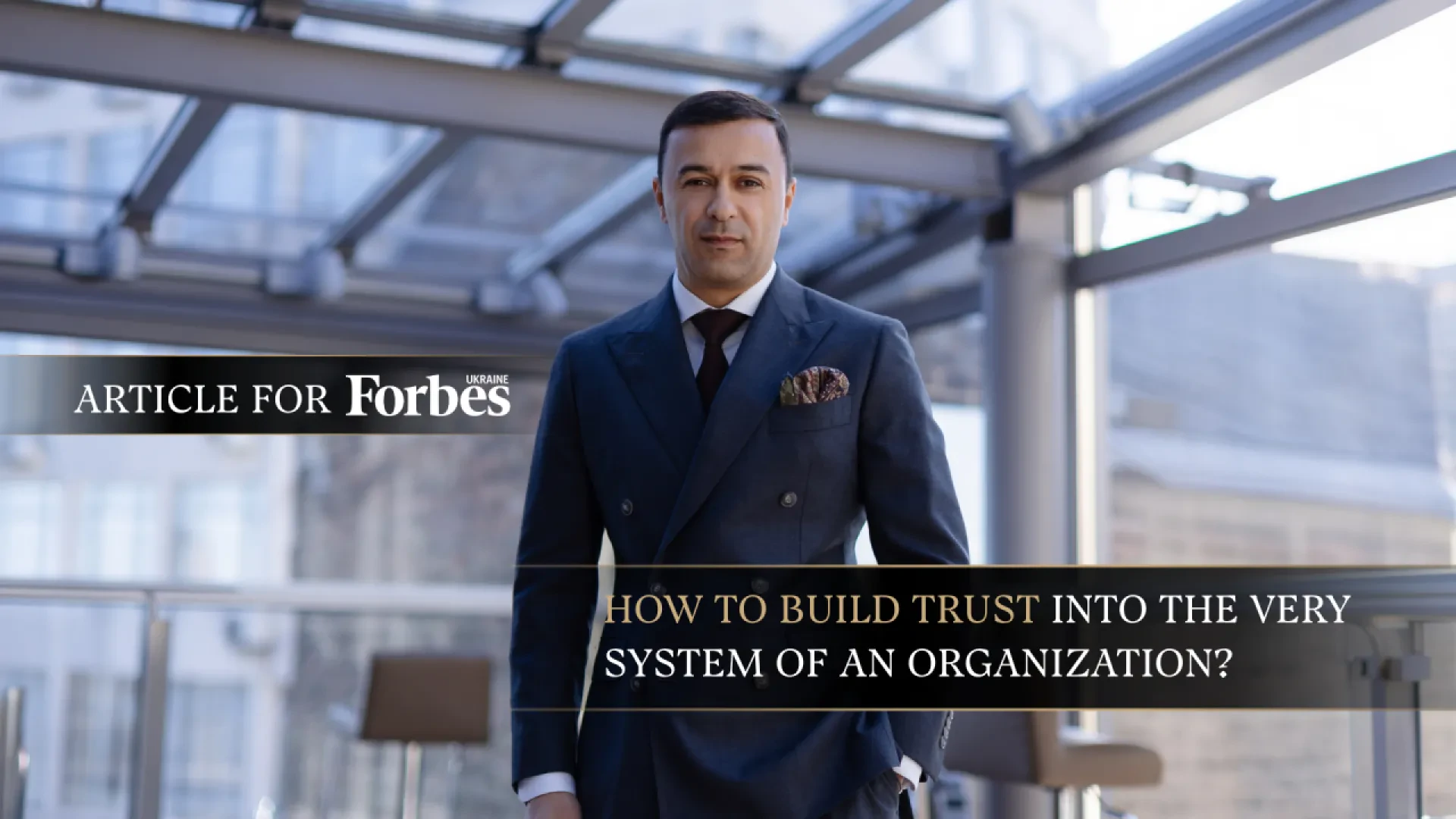
How can trust be embedded into the very system of an organization?
Several years ago, at CEO Club, we faced a situation that could not be judged by a contract or internal rules alone. One of the members brought several others into a business project that ended in significant losses for them. Formally, it was a private dispute between entrepreneurs. Over time, however, it became clear that what was at stake was not one agreement, but trust within the entire community.
Over nearly 15 years of building CEO Club, which today brings together around 300 members, I have been convinced again and again that it is not enough to call trust one of our values. I tend to think of it as infrastructure. A value can remain a belief or a declaration, whereas infrastructure determines whether a system is able to function at all. In business, it determines how we choose partners, pool resources, enter new markets, and make decisions on incomplete information.
There is no doing without formal mechanisms: a contract records mutual obligations, an audit helps verify the facts, and the courts are meant to protect rights that have been violated. But institutions often move more slowly than the environment changes, and a business has to act before every check is complete. At that moment, trust allows us to move from information to a decision before exhaustive guarantees exist.
Not Starting Every Decision from Scratch
Infrastructure has value precisely because it does not have to be built anew for each subsequent action. We use a road or a digital protocol by relying on their ability to work repeatedly. Trust performs a similar function in relationships between people: an accumulated record of behavior becomes the basis for the next decision. When trust is absent, we have to verify information all over again, tighten oversight, and spend time confirming basic agreements. These actions may be rational, but they raise the cost of coordination and deprive a business of speed at a time when the window of opportunity stays open only briefly. Francis Fukuyama described this dependency in his book Trust. He showed that societies capable of extending trust beyond the family and the clan build large, flexible organizations with lower coordination costs. What matters to me is the mechanism itself: the wider the trust, the cheaper and faster the interaction. In a predictable environment, vertical systems can be effective. In turbulence, however, the cycle of approvals turns into inertia, while horizontal networks respond faster. For that, trust must exist between the people within them; without it, flexibility turns into chaos.
A recommendation from someone whose behavior you have observed for years does not remove the need to vet a potential partner. It helps you understand what exactly needs to be checked, which risks are real, and whom to ask the right questions.
The Boundary You Cannot See in a Contract
Formal rules work where a violation can be described in the language of a contract, a law, or an internal policy. Harder are the situations in which each separate action looks permissible, but the sequence of them forms a pattern of behavior incompatible with responsible relationships.
In the case at CEO Club, the scale of the problem did not become clear at once. Later, other stories with a similar script began to surface. Taken separately, each could be explained as an unsuccessful project or an ordinary commercial risk. Together, they showed a different picture: promises had gone unkept for years, the person avoided the conversation, and the trust that came with belonging to the club was becoming a way to attract new partners.
I looked into the circumstances more closely and asked the Ethics Committee to return to the matter. What interested me was not the fact of a formal violation, but whether the members’ trust had been used, and whether such a pattern of behavior created a risk for the club. After a second review, the decision was taken to expel the member.
A community cannot guarantee the success of every deal or take on the role of arbitrator in every commercial dispute. That would relieve entrepreneurs of responsibility for their own decisions and turn trust into a collective guarantee for other people’s risks. But it cannot stand aside when belonging to an environment of trust is systematically used as an instrument of access to people, capital, and reputation.
When Trust No Longer Depends on the Founder
In the early years, a community rests largely on its founder: people rely on the founder’s reputation and vision, and the founder puts the most energy into the system. At CEO Club, I saw how, as the community grew, this advantage became a constraint: trust cannot depend on decisions that one person is able to hold together alone.
At a certain point, I understood that I had to direct my own influence toward creating the mechanisms that would limit that influence. At CEO Club, key decisions are made by the Board and the committees. On principle, I chair none of these bodies and have one vote alongside the others. For me, this is not a refusal of responsibility: I am responsible for the quality of a system able to scrutinize my ideas as well.
What scales is not the founder’s personal reputation or the number of people they know, but a standard of behavior embedded in rules, in procedures, and in the willingness to respond to violations regardless of a person’s status.
Infrastructure That Cannot Be Built Quickly
Trust rarely appears on a list of business assets, although it directly affects the speed and the cost of interaction. It cannot be created by a leader’s decision or by a declaration of values: it accumulates through consistency of conduct, transparency in difficult decisions, and the same rules applied regardless of personal closeness or status.
I am convinced that, increasingly, it will not be only companies that compete, but the environments they belong to. The advantage will lie with those able to find expertise quickly, pool resources, and move from intention to joint action. In the new world, trust becomes faster than institutions only where it has turned from a value into infrastructure.